

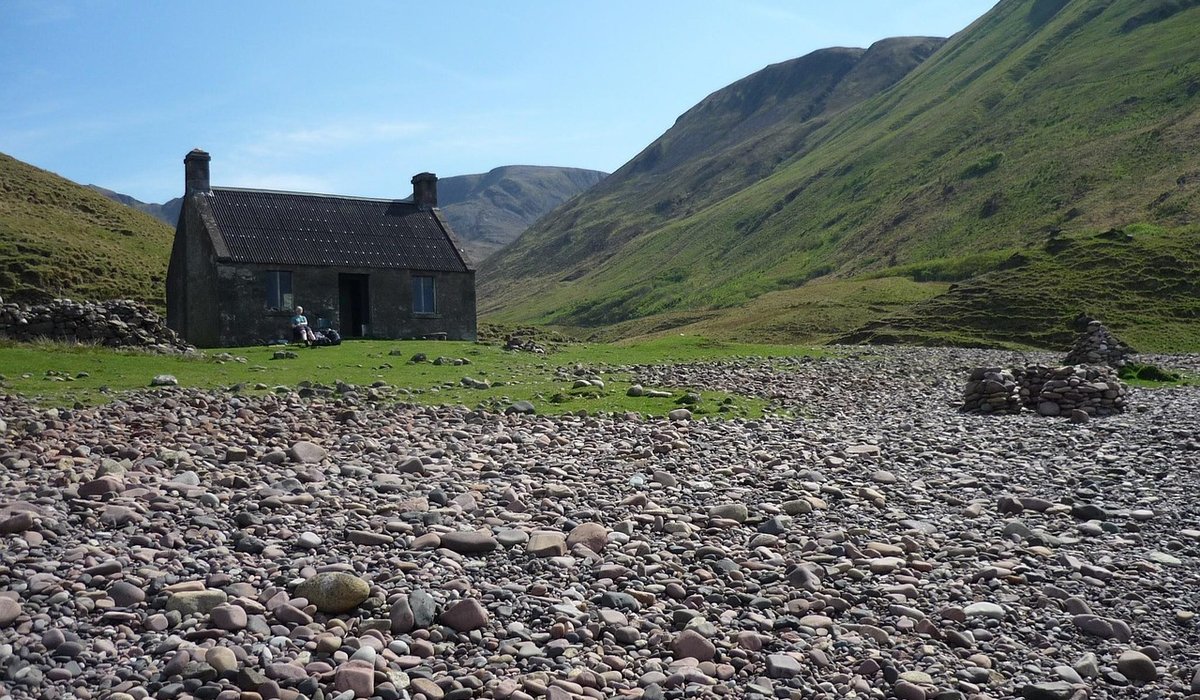
Why dusk is the bothy's best hour
A Highland bothy is more than four walls and a tin roof. It is a pause in the landscape, a relic of drovers and shielings, and a place where folklore still feels close. At dusk, the hills lose their detail and the bothy becomes a silhouette: isolated, stubborn, human. The trick is to photograph that character without losing the warmth inside. A tripod is not optional. Blue hour gives you even, cool light; a candle or lamp behind a window gives the warm counterpoint. Together they tell the story of shelter in a wild place.
Arrive an hour before sunset. Walk the last mile slowly, looking for the angle that shows the bothy's isolation: a bend in the path, a loch in the foreground, a ridge behind. Don't wait until the light has gone to decide where to stand. Scout in daylight, then return to your chosen spot when the colour starts to fade.
Walk in with a plan and a story in mind
Bothies sit at the end of long walks, so treat the journey as part of the photograph. Check the weather, carry a map and compass, and tell someone your route. Many bothies are reached by old drovers' roads or stalkers' paths, and the local history is written into the ground: runrig, shieling mounds, the remains of township walls. Knowing that a path was used by cattle drovers or that a glen was cleared in the nineteenth century changes how you see the building.
- Check the midge forecast — a still dusk is beautiful but biting; a light breeze helps.
- Pack a headtorch — you will walk out in the dark, even in summer.
- Carry a tripod — a lightweight one is better than none, but weight matters over rough ground.
- Respect occupants — bothies are shared shelters, not film sets. Ask before photographing anyone inside.
Time the blue hour and expose for the window
Blue hour in the Highlands is generous in summer but brief in winter. Start shooting about twenty to forty minutes after sunset. The sky will be a deep blue, the hills almost black, and the bothy's window will glow like a coal. Set your tripod low and level. Use ISO 100–400, an aperture of f/8 or f/11, and a shutter speed of two to twenty seconds. Expose for the window: if it blows out to white, you lose the warm light that makes the picture. If the sky goes too dark, bracket your exposures and blend later, or simply wait a few minutes for the balance to shift.
- Focus manually — autofocus can hunt in low light. Use live view and magnify the window edge.
- Use a remote release or two-second timer — even a gentle press moves the tripod.
- Check the histogram — keep highlights in the window under control; shadows can be lifted later.
- Try a warm white balance — around 4000K can enhance the blue-orange contrast without looking fake.
Compose for isolation, not just architecture
The bothy should feel small. Include a winding path, a sweep of heather, a loch, or a broken wall. A foreground of wet rock or birch scrub adds depth. If there is a reflection, use it. Avoid car parks, signs, and power lines. A telephoto can compress the building against a mountain, whilst a wide lens can exaggerate the emptiness around it. In wind and rain, embrace the weather: a blur of cloud or a smear of rain on the lens can suggest the bothy's exposure. Just be careful not to let a wet lens ruin the window glow.
Look for the light inside. A candle, an oil lamp, or a diffused headtorch behind a curtain will read as warm and inviting. If you are staying, light it safely and briefly. If others are inside, ask first. Never shine a torch directly at the window from outside; it kills the mood and disturbs the people within.
Folklore, courtesy and the walk out
Highland folklore is full of shelter and danger. The each-uisge, or water horse, was said to lure travellers to lochs; fairy hills were left alone; drovers told stories to keep their cattle calm. A bothy at dusk sits between those worlds: a human refuge in a landscape that still feels older than us. Let that story enter the frame, but do not invent it. Research the glen's history, learn the placenames, and photograph with respect.
Leave the bothy as you found it: swept, tidy, no litter. Carry out all rubbish, including food scraps. Close the door against the wind. On the walk out, use your headtorch, keep to the path, and enjoy the last of the blue light. A flask of tea at the car is a fine reward. The best bothy photographs are not just technically sharp; they carry the cold air, the long walk, and the small warm rectangle of a window that says someone, or something, is home.


Coding is used in almost all aspects of life and work now, be it directly or indirectly. It’s not just for companies in the tech sector. “An increasing number of businesses rely on computer code,
Coding is used in almost all aspects of life and work now, be it directly or indirectly. It’s not just for companies in the tech sector. “An increasing number of businesses rely on computer code,
Coding is used in almost all aspects of life and work now, be it directly or indirectly. It’s not just for companies in the tech sector. “An increasing number of businesses rely on computer code,